Function activators
A function activator deploys a function so that it runs outside Legend Studio: as a REST service that applications call, or as a function inside a Snowflake or MemSQL database. It names the function, says how and where it runs, and who owns it. Here, InitialsService makes initials, which turns a first and a last name into their initials, a REST service.
Activate a function
Activate, at the top right of a function's editor, creates an activator for the function.
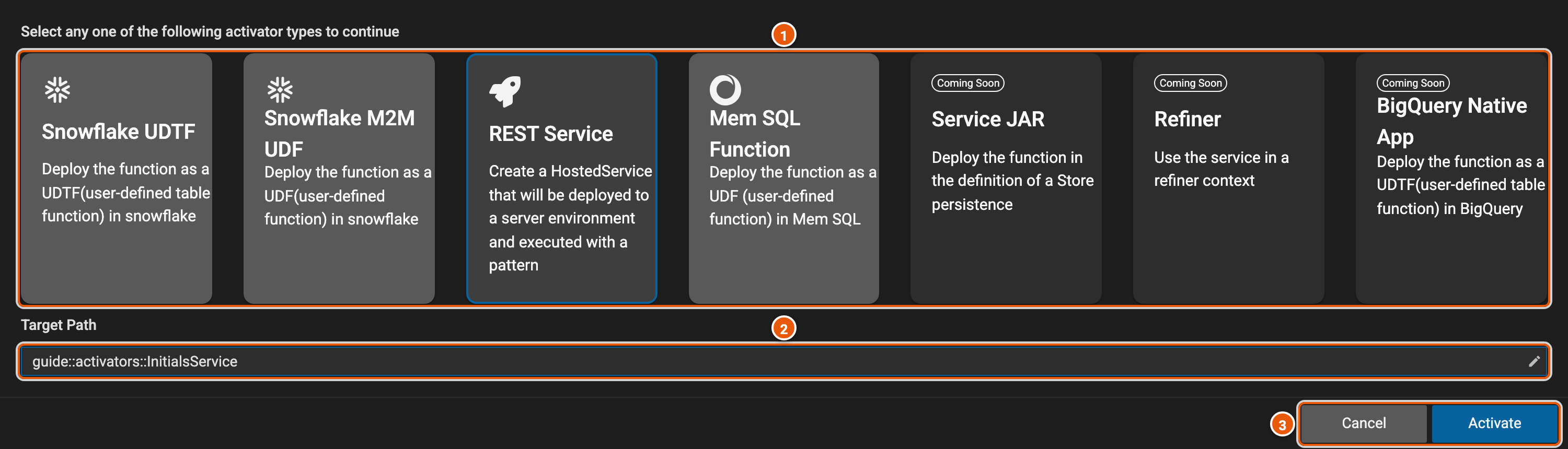
- The kinds of activator. Snowflake UDTF, the default, deploys the function as a user-defined table function in Snowflake; Snowflake M2M UDF as a user-defined function in Snowflake; REST Service as a service that answers at a URL; and Mem SQL Function as a user-defined function in MemSQL. Service JAR, Refiner and BigQuery Native App are coming soon.
- Target Path: the new activator's package and name. It starts as NewActivator, in the function's package.
- Activate creates the activator and opens it. It stays disabled for a kind that needs a database connection the project doesn't have: a Snowflake one for the Snowflake kinds, a MemSQL one for Mem SQL Function.
A new REST service gets a random URL pattern, and an owner to fill in.
A REST service
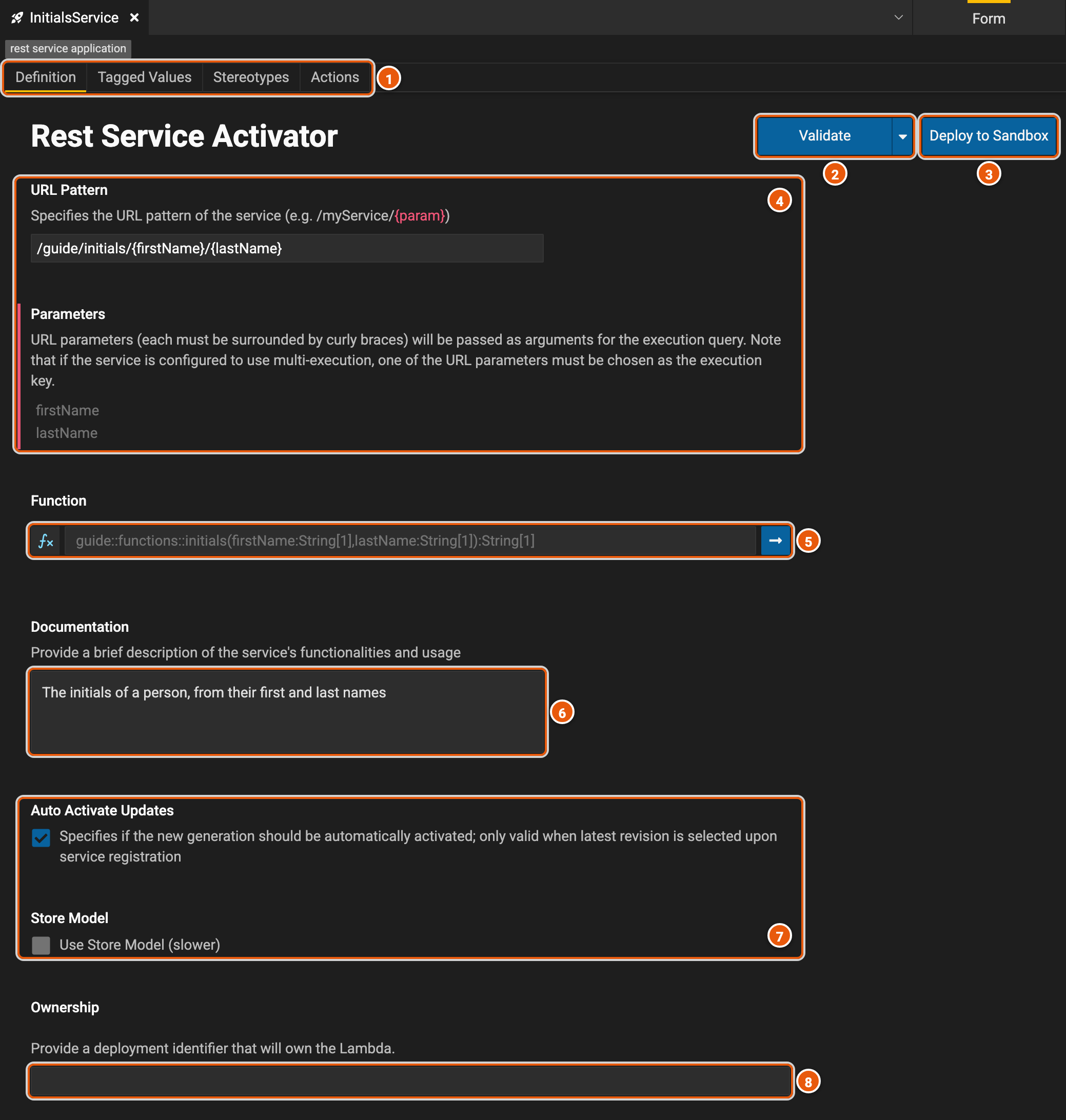
- The tabs: Definition, below; Tagged Values and Stereotypes, as on a class (see Profiles); and Actions, which run after the service is deployed. The kinds of action come from extensions to Legend Studio, so a Legend Studio without them offers none.
- Validate has the engine check the activator before you deploy it: for instance, that the parameters in the URL pattern are the function's. It then says Hosted Service is valid, or what is wrong. The arrow beside it has Render Artifact (see The artifact).
- Deploy to Sandbox deploys the activator, as it is in your workspace, to a sandbox, to try it out.
- URL Pattern: the path the service answers at. A part in braces, as in
/guide/initials/{firstName}/{lastName}, is a parameter: its value, from the URL, goes to the function's parameter of the same name. Parameters lists them. - Function: the function the service runs. The arrow opens it.
- Documentation: what the service does, and how to use it.
- Auto Activate Updates: when the service is registered from the project's latest revision, each new registration of it is used at once. Store Model makes it use the store model, which is slower.
- Ownership: the identifier of the deployment that owns the service.
The artifact
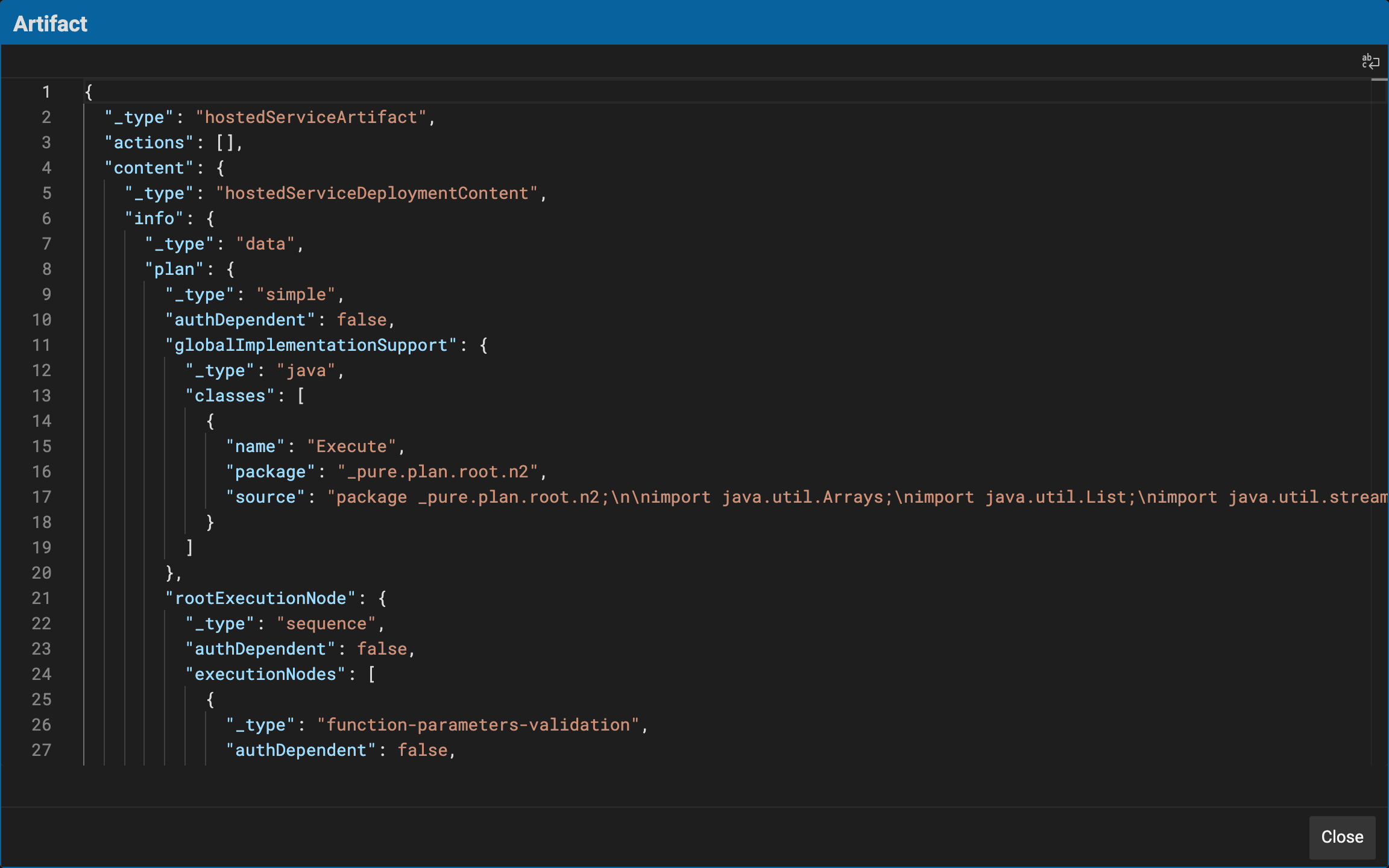
Render Artifact shows what the activator deploys, as JSON. For a REST service, that is the engine's plan to run its function, then the service's URL pattern, its owner and the service itself.
Snowflake and MemSQL activators
A Snowflake UDTF, a Snowflake M2M UDF and a Mem SQL Function have the same function and owner as a REST service, and the same Validate, Render Artifact and Deploy to Sandbox. They also have the Connection to the database they deploy to, the name of the function to create there, and a description. A Snowflake UDTF also has a Permission Scheme, a Usage Role and a Deployment Schema, and a Snowflake M2M UDF a Deployment Schema and a Deployment Stage.